
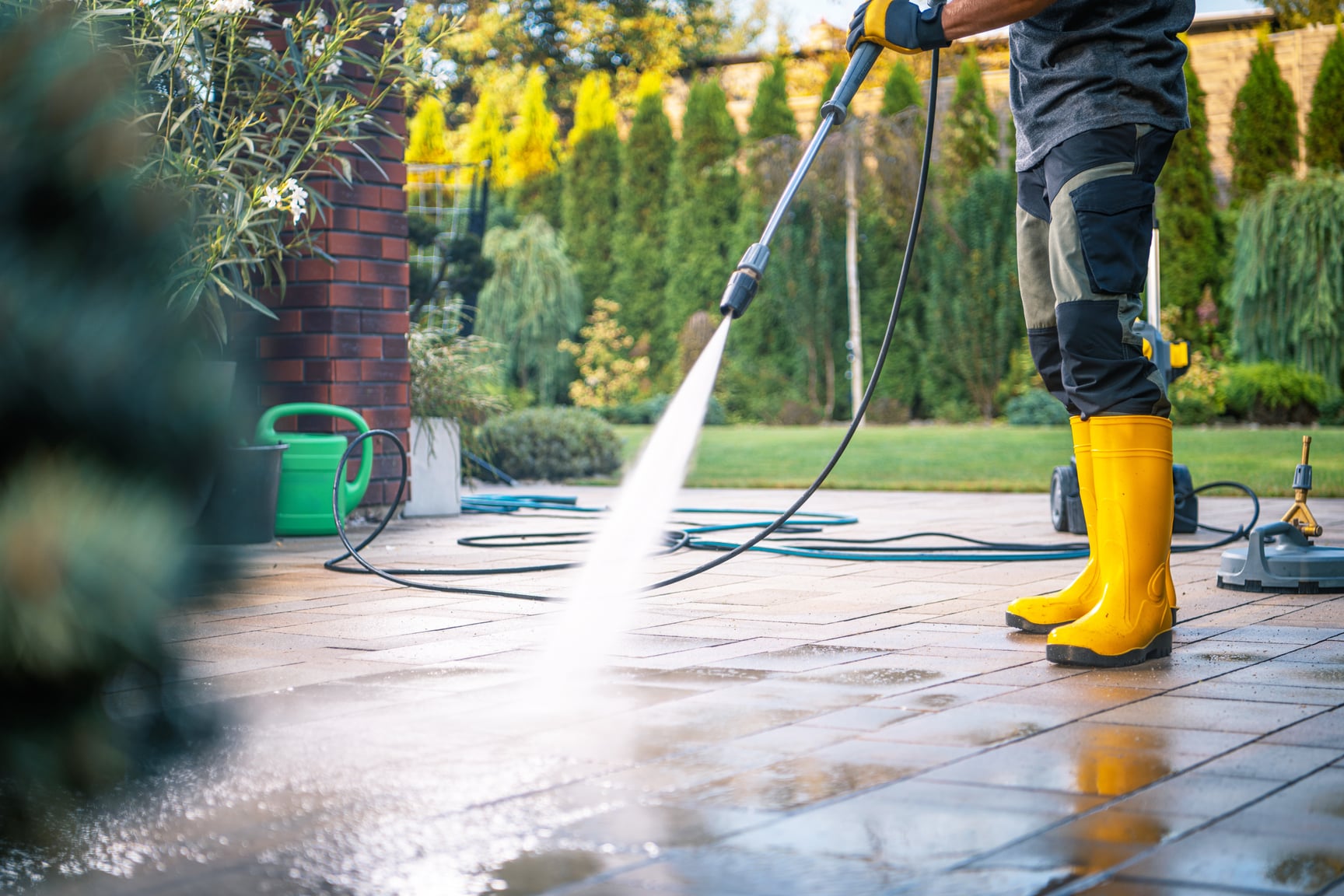
Pressure washing insurance is business coverage for a trade whose work lands on a customer’s driveway, siding or storefront, and whose income rides on a trailer of machinery. It is built from policies that can answer for damage and injury the work causes, protect the rig and the truck, and cover the people on your payroll.
We write pressure washing company insurance for the owner-operator who runs a truck and a trailer out of a home garage, and for the crew that has added rigs, helpers and commercial routes. The account starts from the services you sell, because an underwriter may price a residential driveway route, a roof-washing sideline and a restaurant pad contract differently.
Who this program is written for
Picture the owner who answers the phone between jobs, keeps the surface cleaner on the trailer and the chemicals on a shelf at home, and books a helper for the spring rush. That owner needs coverage that follows the rig from the house to the job site, answers a customer who blames the wash for a cracked pane, and does not assume a personal auto policy will answer for a working truck. The program here is written to that owner first.
It is also written for what comes next. Growth changes the account in specific ways: a payroll appears, another vehicle may need a driver list, a property management company sends its vendor packet, a general contractor wants your certificate before you set foot on its site. Each of those is a moment to call the agent rather than a surprise at renewal.
Residential routes and commercial lots
On a residential route the customer may be home, the job can be finished in an afternoon, and the person paying knows exactly how that driveway looked before you arrived. Storefront and lot work turns that around: the client is a manager or a landlord, the job may run before opening or after closing, and a certificate can be part of winning the job in the first place.
For an underwriter the difference is the mix. A quote can ask what share of your revenue comes from each kind of work, because commercial jobs can bring larger surfaces, more people near the work and written contracts.
Power washing: the same trade under another name
This heading is here because people search for the other name too. For a business that advertises as a power washing company, nothing on this page reads differently.
What soft washing adds to an application
Soft washing adds questions an insurer may ask. Expect the application to ask which cleaning agents you buy, how you dilute and apply them, whether you wet and rinse plantings, how you shield metal fixtures and vehicles nearby, and how rinse water leaves the site. Detailed answers help; a vague one can lead to an exclusion or a declined quote.
The liability wording that bears hardest on this work is explained on the general liability page, in its section on chemistry; read it there before you compare quotes.
What roof jobs change on a quote
Adding roof work changes the answers on a quote in specific ways. There is the crew: ladders, harnesses and wet pitched surfaces bring injuries a ground-level crew does not face, and workers’ compensation can be priced on what people actually do. There is the building: a roof has to keep the weather out after you leave, and a customer who finds a leak or a damaged shingle will connect it to your visit. And there is acceptance: insurers can differ on roof work, so name it on the application and check the quote for it.
Driveways, lots and loading docks
Flatwork can be the job a customer inspects the next morning, standing on it. It also scales: the equipment that cleans a driveway will clean a parking deck or a loading dock, and the step from one to the other is where the insurance questions can change. Bigger sites add their own conditions: crews working while a lot is closed, traffic passing the work zone, rinse water to account for, and terms set down in writing. Tell the agent when you start bidding that work, not after you win it.
Dumpster pads and the water that leaves them
Pad cleaning can be scheduled work for food businesses, shopping centers and multifamily properties, and its insurance questions begin with the water. What runs off a pad may not be clean rinse, so an underwriter may ask how you contain and recover it, where it goes for disposal, and whether you work near storm drains. Berms, drain covers and vacuum recovery units belong on the application. Those details, not the cleaning itself, are what this work adds to an application; the discharge question belongs to the general liability page.
Fleet washing and exterior building cleaning
Fleet washing brings a client’s vehicles under your hands, sometimes a whole yard of them on a weekly route. Whether damage to a vehicle you are cleaning is covered can turn on care, custody or control wording; list vehicle washing as a service in its own right on the application.
Building exteriors sit at the other end of the scale: facades, awnings, signs and parking structures, sometimes worked from a lift. Height and the public walking beneath the work enter the underwriting, and a building owner may write insurance terms of its own into the job.
The risk that defines a wash business
Every section above circles one exposure: harm to a customer’s property in the course of the job. The general liability page takes it apart clause by clause, and general liability insurance for pressure washing businesses is the line to settle first in any quote.
The question each policy answers
Insurance for pressure washing businesses is assembled from the policies below, and the machine-only cover some owners call pressure washer insurance is a single card among them. Read each card as a question; the linked page answers it in full.
General Liability
Who answers when the job injures a bystander or marks up what belongs to a customer?
Claims from customers, neighbors and passers-by, and, depending on the form, the legal defense.
Equipment Coverage
What happens when the rig is stolen or wrecked?
The washers, hoses, tanks and the trailer that carries them, on the road and at the job, depending on the form.
Property
What protects what you keep at the base?
Spare parts, stored supplies, office gear and, depending on the form, records, at home or in a rented space.
Workers’ Compensation
Who pays when someone on the payroll is hurt?
The helper who falls from a ladder or burns a hand on a hot-water unit, and, depending on the form, the lawsuit that can come with it.
Commercial Auto Insurance
Which policy follows the truck?
The work truck on the road, the people allowed to drive it, and, depending on the form, what it tows.
Umbrella
Who pays past the limit?
A reserve of liability protection that can sit over the truck, the job site and the payroll, depending on the form, written as a single extra layer.
Which of them an account carries, and in what order they are added, depends on the business; the coverage overview sets them side by side.
Several kinds of client surround the business. The homeowner, the homeowners association, the property management company, the commercial client and the general contractor each connect to it by the arrangement under which they hire you: residential work, common areas, a vendor packet, a service contract or a subcontract. Each node notes what that client is after; the contract’s own words decide what is required. No figures are shown.
The clients who ask for proof of insurance
Proof of insurance can decide a sale, because some clients ask for it before they say yes.
- Homeowners associations approve vendors for common areas, and sometimes for work on members’ homes, and may keep a list of contractors whose certificates are on file.
- Property management companies send a vendor packet with insurance terms and watch expiry dates; a lapsed certificate can pause your access to the properties they manage.
- Commercial clients and general contractors put insurance terms in the contract itself, and those terms can call for specific endorsements, not only a certificate.
What those terms mean is the general liability page’s subject. The habit worth building here is to treat a client’s insurance terms as part of the bid itself, a cost line beside chemicals and fuel, rather than paperwork after the handshake.
Moving in order, the figure follows a complaint from the customer’s call through the owner’s record of the site, the report to the agent and the insurer’s review, to an outcome that may be a repair, a payment or a finding of no coverage. Your own policy’s conditions set the details at every step. No figures are shown.
When a customer says the wash caused damage
A claim can begin as a phone call from an unhappy customer, and the way that call is handled shapes what follows.
Look and record. Visit if you can, photograph what the customer is pointing at, and write down when they first noticed it. Avoid promising payment or admitting fault on the spot: a policy may require the insurer’s consent before you settle, and an early promise can complicate a claim you would otherwise have had help with.
Tell the agent early. Liability policies can require prompt notice of an occurrence that may lead to a claim, and late notice can give an insurer grounds to dispute coverage. A complaint that comes to nothing costs a phone call; one reported late can cost the coverage. Reporting a complaint can be a separate step from filing a claim.
Decide small repairs with open eyes. Paying for a minor fix yourself can be sensible, and some policies carry a provision meant for exactly that, described on the general liability page. Ask how your own policy treats it before you write the check.
Ordinary days that end in a claim
- The trailer that came loose. A hitch fails on the way to a job and the trailer crosses into traffic: a question for the truck’s policy, with the umbrella above it where one is carried.
- The cracked storefront glass. A wand slips during a lot cleaning and a display window gives way while shoppers are inside.
- The break-in at the home shop. Stored chemicals, a spare pump and the office laptop disappear from the garage overnight.
- The hot-water burn. A fitting lets go on a heated unit and scalds the helper holding the gun.
None of them needs a careless crew. Each lands on a different card in the program above.
Why similar wash businesses get different quotes
Picture an owner who works alone on driveways and decks, and a crew that does the same work plus restaurant pads and roofs, with helpers on the payroll and another truck in the yard. The crew’s quote can come back higher for reasons that have nothing to do with how well it works: pads and roofs carry their own questions, a payroll brings workers’ compensation into the picture, and the extra truck may need its own place on the auto policy. A quote built on guesses can be priced cautiously, so the more exact the answers, the better. The quote request asks for each of these.
Location plays a part too; our state pages cover the states where we place wash businesses.
What an underwriter looks for in a wash business
Beyond the figures, an underwriter is judging how the business is run. Written work orders, a habit of recording site conditions, a mixing log for chemicals, trained helpers and certificates collected from any subcontractor can read as signs of a well-run company. Underwriters can also weigh years in business and the owner’s own experience.
When a quote comes back with an exclusion or a decline, the reason can be a single service the insurer does not want, or an application that left too much unexplained. The answer is to place the account where that work is welcome, never to leave the work off the application.
Getting a quote
Send a request for pressure washing business insurance, and the agent comes back with offers from more than one insurer, laid out together so the wording can be compared and not just the price. Questions about any line are answered before anything is signed.
Keeping the program current as the business changes
A wash business changes faster than an annual policy term: gear is added, helpers come and go with the season, routes and services expand. The habit that keeps the program sound is a short call to the agent before a change, rather than a list at renewal, so the policies describe the business as it stands on the day of a loss.
At renewal the program gets a fuller look: the year’s revenue and payroll, any claims, the contracts that came in, and whether the limits still match what clients ask for. It is also the moment to ask whether a line you skipped in the first year now belongs.
Why Pressure Washing Business Insurance
This site is about one trade: wash businesses. The agency behind it, Wexford Insurance, LLC, is led by Nate Jones, CPCU, who reviews what is published here. Working in a single trade means asking early which insurers will consider roof or pad work, and what each may ask before it quotes. Meet the people behind the agency, or visit the blog for guides as they are published.